 As e-bikes become an increasingly common sight on Fairfax County streets, trails, and neighborhood roads, county leaders and law enforcement are working to balance their many benefits with growing concerns about rider safety—particularly among young riders.
As reported recently by Scott McCaffrey of FFXNow, at its June 23 meeting, the Fairfax County Board of Supervisors discussed the rapid growth in e-bike use and agreed that education should be the first priority. Board Chairman Jeff McKay noted that most e-bike riders are following the law and praised e-bikes for providing valuable transportation options for teenagers and others who may not have access to a car. At the same time, supervisors expressed concern about recent crashes involving e-bike riders and emphasized the need for safe, responsible riding. Supervisor Walter Alcorn warned that without greater awareness, serious injuries are likely to increase, while Supervisor Dalia Palchik, herself an e-bike rider, called for expanded public education on riders’ rights and responsibilities.
The Board also approved an update to the county’s helmet ordinance. Beginning this summer, riders under age 15 must wear a helmet while operating bicycles, e-bikes, scooters, and motorized skateboards on local roads, expanding the previous requirement that applied only to bicycles.
The Fairfax County Police Department recently reinforced many of the same messages in a public safety campaign. Police encourage riders to wear helmets, understand where different devices may legally operate, obey traffic laws, yield to pedestrians, and make sure parents understand the differences between legal e-bikes and higher-powered electric motorcycles, sometimes marketed as “e-bikes,” that generally are not permitted on public roads, sidewalks, or trails.
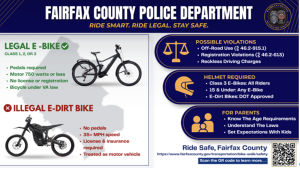
Virginia law recognizes three classes of e-bikes, all with operable pedals and motors of 750 watts or less. Class 1 and Class 2 e-bikes provide assistance up to 20 mph, while Class 3 pedal-assist e-bikes provide assistance up to 28 mph and require riders to be at least 14 years old. Higher-powered electric dirt bikes and mini-bikes are treated differently under state law and generally cannot be operated where bicycles are allowed.
FABB welcomes the Board’s emphasis on education, courtesy, and responsible riding. E-bikes are helping more people choose bicycling for transportation, recreation, and errands, and they are especially expanding mobility for older adults, commuters, families, and people who might not otherwise ride.
We also recognize that safely accommodating growing numbers of cyclists ultimately requires continued investment in safe infrastructure. Protected bike lanes, wider shared-use trails, safer intersections, and better-connected bicycle networks help reduce conflicts among cyclists, pedestrians, and motorists while making riding safer for everyone.
As more Fairfax County residents discover the benefits of e-bikes, all of us—whether walking, bicycling, driving, or riding an e-bike—share responsibility for making our streets and trails safe. A little patience, respect, and understanding can go a long way.


