 Fairfax City is considering a new approach to improve bicycle and pedestrian connectivity after the City Council’s decision earlier this year to cancel the planned George Snyder Trail extension.
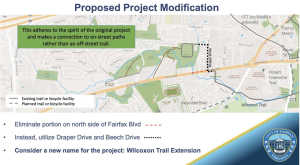
According to a recent FFXNow report, city staff have proposed modifying the project formerly known as the George Snyder Trail Extension and renaming it the Wilcoxon Trail Extension. Rather than connecting to the trail network through parkland, the revised concept would use on-street facilities along Draper Drive and Beech Drive to connect the existing Wilcoxon Trail to Draper Drive Park.
The proposal represents an effort to preserve many of the connectivity benefits envisioned in the original project while responding to the City Council’s January decision to cancel the George Snyder Trail extension through Stafford Drive and Ranger Road parks.
For FABB, the most important question remains whether Fairfax City can continue making meaningful progress toward creating a safe, connected network for people who walk, bike, and roll. The original George Snyder Trail extension would have provided valuable east-west connections and improved access between city neighborhoods and Fairfax County’s broader trail system. While its cancellation was a setback for active transportation, we are encouraged that city staff are actively seeking alternatives rather than abandoning connectivity improvements altogether.
The proposed Wilcoxon Trail Extension would help address a long-standing gap in the trail network. Today, the Wilcoxon Trail crosses Blenheim Boulevard and ends south of Fairfax Boulevard, limiting its usefulness as a transportation corridor. The revised project would seek to extend connections through the surrounding neighborhood street network and improve access to parks, schools, homes, and destinations along Fairfax Boulevard.
Importantly, city staff have indicated that the revised proposal appears consistent with the intent of the project that received $9.5 million in state Smart Scale funding. Maintaining eligibility for that funding is critical. Following the cancellation of the George Snyder Trail project, Fairfax City received a bill from VDOT for $3.7 million in concessionaire funding associated with the canceled trail. Staff believe the proposed project modification offers a path forward that preserves transportation benefits while complying with state funding requirements.
The next step will be a feasibility study, estimated to cost approximately $110,000. The study will evaluate whether a shared-use path or separated bicycle and pedestrian facilities would best serve the corridor, identify potential impacts on parking and utilities, assess any right-of-way needs, and refine project cost estimates.
Encouragingly, city staff do not anticipate significant tree removal and expressed optimism that utility relocations may be avoided.
Several City Council members voiced support for exploring the revised concept. Councilmember Thomas Peterson specifically highlighted the proposal’s potential benefits for bicycle safety and neighborhood connectivity, while Councilmember Stacy Hardy-Chandler praised the effort to find a viable alternative after the George Snyder Trail cancellation.
FABB will continue to follow the project as the feasibility study moves forward. While no replacement can fully replicate the connectivity that the original George Snyder Trail extension would have provided, we support efforts to advance practical, fundable projects that improve safety and mobility for people of all ages and abilities.
Creating a connected transportation network requires persistence and flexibility. We look forward to working with Fairfax City to ensure that the revised project delivers meaningful benefits for bicyclists, pedestrians, and the broader community.
Want to help FABB with our advocacy? Contact us at [email protected].


