 Too often, opponents of bicycling infrastructure dismiss advocates for wanting to impose European ways on American transportation systems.
- Nothing could be farther from the truth, and, in fact, American localities across the country are showing how to resolve the problems caused by our transportation system.
FABB recognizes that our mixed urban-suburban county is unique in its challenges and resources when it comes to dealing with the people’s need for mobility and the accompanying issues of traffic congestion, pollution, and safety. We believe, however, that the time is now to create biking networks that improve public safety and health, reduce congestion and carbon emissions, lower car dependency, and boost the economy.
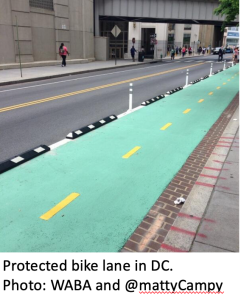
FABB is not working to recreate the Netherlands in Northern Virginia (as nice and beneficial as that would be for everyone). Instead, we advocate for the political will to follow American examples of building bike networks and related improvements being applied to fit local needs in municipalities like our neighbors in Washington, DC, in Pittsburgh and Austin, and even in and around New York City.
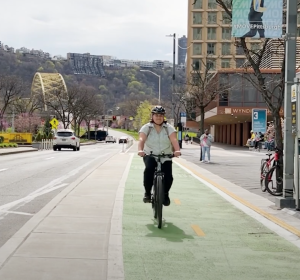
Mixed protected and paint bike lane in Pittsburgh. (Photo: PeopleforBikes)
The relatively small District of Columbia created 24 miles of protected bike lanes between 2009 and 2021 and is on track to complete an additional 20 miles of protected bicycle lanes this year. DC plans to 10+ miles of protected bike lanes each year over the next three years. After setting an ambitious goal in 2019 to build a 220-mile, safe and connected network of on-street and off-street facilities, Pittsburgh has completed approximately 65 miles of combined shared-use paths, protected bike lanes, and traffic-calmed “neighborways” throughout the city. Austin, Texas, meanwhile, accelerated project construction and completed 115 miles of new bike lanes to achieve a 50% build-out of its All Ages and Abilities Mobility Network in only 24 months!
Because of its pedestrian and bicycle infrastructure and safety improvements, New York City is significantly outperforming national-level safety figures, reducing its traffic death rates while the overall US death rate rose over the past few years. Over in New Jersey, Hoboken, with 60,000 citizens, has not had a traffic death in four years by relying on inexpensive intersection designs, particularly “daylighting” or the removal of curb parking spaces around an intersection to increase visibility for pedestrians, cyclists, and drivers. Nearby Jersey City has not had a single traffic fatality so far this year on non-state roads (but five on state roads) thanks to an expansion of road diets and bike lanes and smaller scale projects like curb bump-outs.
Replicating the success of these places, however, will take a lot of investment, not just in money but also in the time and effort of advocacy groups like FABB to press government and transportation departments to prioritize bicycle infrastructure and its demonstrated major “bang for the buck” impact on creating a safer, greener multimodal transportation network.
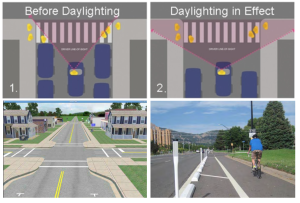
Top: Daylighting example. Bottom Left: Curb bump out. Bottom Right: Parking stops and posts for low cost protected bike lane.
Last month, the Fairfax County Board of Supervisors approved $5 million for active transportation and maintenance projects to improve the county’s pedestrian and bicycle infrastructure while setting a goal to identify $100 million of projects to be implemented over over a six-year period. This is great except the time period should be shortened and, for a county of over 1 million people, compares poorly in its ambition to the localities mentioned above.
This is why, in 2023, we want to increase our efforts to get local transportation decision makers and planners to:
- Group planned projects that prioritize safe biking to popular destinations together and build them simultaneously into a network rather than continue to add bike infrastructure sporadically and on the cheap through the annual repaving and restriping program.
- Upgrade existing bike lanes NOW with low-cost barriers (concrete parking stops) and paint (lots of it) to create visible separation between bikes, cars, and sidewalks.
- Create a near-term plan to complete the primary bike networks in the county’s Active Transportation Plan by connecting the existing gaps.
- Develop and rapidly implement an equity program for safe biking in partnership with members of the county’s underserved communities.
Won’t you help? Please visit https://fabb-bikes.org/donate/ and give now to our annual appeal today.
With your generous support and participation, FABB can continue to press government and transportation departments on these and other issues to make bicycling better in Fairfax County.


