 At FABB, we believe Fairfax County’s trails and shared-use paths should remain safe, welcoming, and comfortable for everyone—people biking, walking, running, rolling, commuting, and simply enjoying the outdoors. But recent reports received by FABB highlight a growing concern: reckless operation of high-speed e-bikes on local trails and shared-use paths, particularly in the Herndon and Tysons areas.
Several riders have described encounters with fast-moving Class 2 and Class 3 e-bikes traveling at unsafe speeds and passing dangerously close to other trail users. In some cases, riders reported e-bikes that more closely resembled small motorcycles than traditional bicycles. These incidents mirror concerns emerging nationwide as communities adapt to the rapid growth of e-bike use.
The Good News–and the Challenge
E-bikes have enormous benefits. They help people replace car trips, extend commuting range, and access transit more easily. They also help people ride despite age or physical limitations and enjoy biking more often.
At FABB, we support responsible e-bike use as an important part of a more sustainable and connected transportation system. But speed and weight matter—especially on crowded shared-use trails originally designed around lower-speed walking and bicycling activity.
Recent national studies have shown sharp increases in e-bike injuries, particularly involving:
- Excessive speed
- Inexperienced riders
- Unsafe passing behavior
- Lack of helmet use
- Conflicts on multiuse trails and sidewalks
Transportation agencies and trail managers across the country are increasingly grappling with how to balance the growing popularity of e-bikes with safety and comfort for all users.
Understanding Virginia’s E-Bike Rules
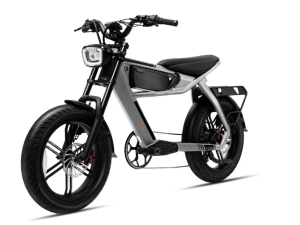
A typical moped-like Class 3 E-bike.
Virginia law divides electric bicycles into three categories:
- Class 1 – Pedal-assist only; no throttle; maximum assisted speed: 20 mph
- Class 2 – Throttle-assisted; Maximum speed: 20 mph
- Class 3- Pedal-assist only; Maximum assisted speed: 28 mph
Under Virginia law:
- Class 1 and Class 2 e-bikes are generally permitted on shared-use paths unless restricted locally.
- Class 3 e-bikes are more limited and may be prohibited on certain trails or paths unless specifically authorized.
- Gas-powered dirt bikes, ATVs, and motorcycles remain prohibited on shared-use trails.
Importantly, legality does not eliminate the responsibility to ride safely and courteously. On trails like the W&OD, riders must still obey posted speed limits, yield appropriately, and ride in a manner safe for surrounding conditions.
Trail Etiquette Matters
A trail is not a racetrack. Even where higher speeds may technically be possible, crowded conditions often require riding much slower—especially near:
- Families with children
- Dog walkers
- Older adults
- Blind corners
- Trail crossings
- Busy urban trail segments
Safe riding means:
- Slowing down around others
- Passing with clear verbal warnings
- Leaving adequate space
- Avoiding aggressive weaving or close passing
- Adjusting speed for trail conditions
Courtesy is one of the reasons trails like the W&OD and Fairfax County’s shared-use path network work as well as they do.
FABB especially encourage parents to help young riders to learn and practice safe, courteous trail behavior. Parents can play an important role by teaching children and teens to control their speed, announce passes, yield respectfully, and ride responsibly—especially when traveling in groups with friends where distractions and risky behavior can escalate quickly.
What You Can Do
If you witness dangerous or illegal activity on a trail, report it immediately to local law enforcement or the appropriate trail authority:
- On the W&OD Trail, contact NOVA Parks here or the local non-emergency police line at (703) 691-2131.
- Note the time, location, and description of the individuals or vehicles involved.
- Contact your Fairfax County District Supervisor to ask for increased patrols and better enforcement of trail rules. Find your supervisor here.
It is also important to encourage safe riding practices within your own riding groups and communities as well as support infrastructure improvements that reduce conflicts and improve safety for all users.
We also encourage local officials and trail managers to continue:
- Improving trail signage and education
- Studying high-conflict areas
- Expanding safe bike infrastructure on roads to better accommodate faster riders
- Supporting data-driven approaches to trail safety and enforcement
Keeping Trails Welcoming for Everyone
The long-term success of active transportation depends on people feeling safe and comfortable using our trails. If families, older adults, or new riders begin avoiding trails because they feel unsafe, support for future trail investments and expansion could suffer. We can avoid that outcome—but only if all users share responsibility for respectful and safe behavior.
E-bikes are here to stay, and they can be a tremendous force for good. The goal is not conflict between riders—it is building a culture where everyone can travel safely together.
At FABB, we remain committed to supporting safer trails, smarter infrastructure, and a welcoming environment for all trail users.
If you have concerns or experiences to share, contact FABB at [email protected]. Together, we can help keep Northern Virginia’s trails safe, accessible, and enjoyable for everyone.


