
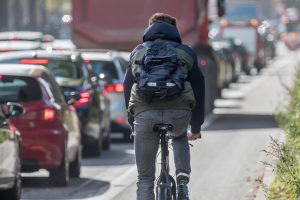
There might be more riders here if the lane were protected.
This is another in our series of PeopleforBikes research-based advocacy talking points posts.
We never forget that, even if bike infrastructure were perfect, not everyone will choose to bike. And that’s fine.
Still, drivers can and should become bike advocates for the simple reason that more people biking means less car congestion to spoil the driving experience.
This was a key messaging point in Austin, where the city completed 115 miles of new bike lanes in just two years! By shifting traffic from cars to bikes and making it easier to reach transit stops, Austin’s planned 400-mile protected bike lane network is projected to increase the city’s traffic capacity by about 25,000 trips per day at approximately the same cost ratio as a single expressway widening.
In 2014, a New York City Department of Transportation (NYDOT) study found that after a six-foot buffered bike lane was installed on Columbus Avenue, car volumes were unaffected and that those cars moved 35% faster. [Take a moment and read that again… 35% faster.] According to an NYDOT statement, the “study found that on corridors with protected bike lanes traffic flow was maintained or improved on average because of the enhanced organization of the roadway.”
Although we lack solid studies on the impact of local bike lanes, FABB has learned from FCDOT that road diets that narrowed travel lanes and included bike facilities in Fairfax County have had a neutral or positive impact on traffic flows. Imagine what a connected network of protected or separated bike lanes could do.
Want to help promote better bicycling through protected bike lanes? Join FABB today!


