 E-bikes help more people in Northern Virginia get to work, run errands, and enjoy a ride. On November 19, NOVA Parks adopted new rules for the Washington & Old Dominion Trail that keep it open to Class 1 and Class 2 e-bikes while prohibiting Class 3 e-bikes, electric motorcycles and dirt bikes, vehicles with motors over 750 watts, and motorized single-wheel devices. The regulation includes exceptions for mobility devices used by people with disabilities.
FABB supports the update. Keeping Class 1 and Class 2 e-bikes on the W&OD preserves access for people who rely on electric assistance for everyday trips and recreation. Clear limits on higher-speed and higher-powered devices also help keep the trail welcoming for everyone who shares it, from families out for a walk to people biking to work.
Shopping for an e-bike? Check the Label
If you’re shopping for a teenager this holiday season, check the bike’s specifications before you buy. Under Virginia law, an e-bike must have working pedals, a seat, and a motor rated at no more than 750 watts of input power. Manufacturers and distributors must affix a label showing the bike’s class, top assisted speed, and motor wattage.
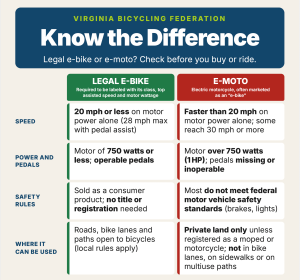
These speeds describe when the motor stops assisting. Everyone using the W&OD should ride at a speed that gives them time to slow down and pass safely, especially around people walking or riding with children.
A product listing may call a device an “e-bike” even if it has no working pedals, exceeds 750 watts, or can go faster than 20 mph on motor power alone. An advertised “off-road” or “unlimited” mode that exceeds the class limits is a red flag, even if the device ships in a slower setting. If the required label is missing or the seller can’t verify the specs, keep shopping. Electric motorcycles and dirt bikes belong off shared-use trails, and buyers should verify whether a device can be titled and registered for public-road use before buying it for transportation.
See VBF’s e-bike and e-moto buying guide.
What Virginia lawmakers can do next
FABB supports the Virginia Bicycling Federation’s work to make streets and trails safer statewide. VBF served on the Department of Motor Vehicles (DMV) workgroup created by Delegate J.J. Singh’s HB 1120, offering research and feedback on safety recommendations and proposed legislation. We thank Delegate Singh, DMV staff, and the stakeholders who contributed. The workgroup’s recommendations include retaining Virginia’s three e-bike classes, improving crash data, expanding public education, and investigating misleading sales practices.
When the General Assembly convenes on January 13, FABB urges lawmakers to act on two VBF priorities.
- Set clear rules for higher-speed electric devices. VBF proposes treating devices that can travel over 20 mph and up to 35 mph on motor power alone like mopeds, with appropriate federal safety standards for brakes, lights, and tires and a manufacturer’s label certifying compliance. Faster devices would be treated as motorcycles. Clear rules would also help Virginia’s attorney general hold sellers accountable for misleading advertising.
- Pass Delegate Willett’s Bicyclist Safety Bill. Its safety-yield provision would let people biking treat a stop sign as a yield sign, slowing down, yielding the right of way, and stopping when necessary. In Delaware, bicyclist crashes at stop-sign intersections fell 23 percent in the 30 months after a similar law took effect, compared with the previous 30 months.
FABB joins VBF in putting education first. Give families clear information before they buy, and hold sellers accountable when they misrepresent what a device can do. Correcting one misleading listing can reach every shopper who sees it.
Help make Virginia’s streets and trails safer.
Share VBF’s buying guide with anyone shopping for an e-bike this holiday season.
Ask your state delegate and senator to support clear rules for e-motos and the bicyclist safety yield in 2027. Find your Virginia legislators here.
Join FABB here and work with us to make bicycling better.


