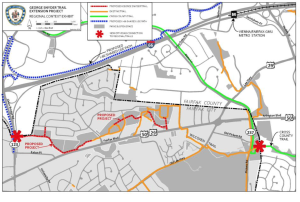
 Earlier this week, according to reporting by Michael O’Connell of The Patch, the Fairfax City Council took a deeply disappointing step backward from safe, connected bicycling and walking. The council voted to terminate the George Snyder Trail extension project, undoing years of planning and prior approvals and foregoing substantial outside funding and overwhelming regional benefits.
The Council first deadlocked 3–3 on whether to accept a $4.6 million grant supplemental appropriation needed to complete the project. Because state law prevents the mayor from breaking ties on appropriations, the funding failed. Moments later, the Council voted 4–2 to cancel the project entirely, with council members Billy Bates, Stacy Hall, Rachel McQuillen and Tom Peterson voting to cancel and Anthony Amos and Stacey Hardy-Chandler voting in opposition.
This decision ends a project that would have completed a critical east‑west active transportation corridor through Fairfax City—linking Chain Bridge Road (Route 123) and Fairfax Boulevard (U.S. 50) and closing a major gap in the Gerry Connolly Cross County Trail.
A Reversal After Years of Commitment
What makes this decision particularly troubling is that the City Council had already voted in June 2025 to move forward with the full trail, recognizing that canceling the project would require the city to repay $3.7 million in concessionaire funding already spent. That obligation was not hypothetical. A 2016 council resolution—signed by the mayor—explicitly committed Fairfax City to reimbursing VDOT if the project were canceled.
Despite that clear obligation, and despite the Commonwealth Transportation Board’s approval of the additional funding just last week, the Council chose to walk away.
As The Patch reported, construction bids came in higher than anticipated—$17.1 million and $18.8 million—requiring an additional $4.6 million beyond the remaining project balance. That gap, while real, was neither unexpected nor unusual for complex infrastructure projects years in the making. It was also fully solvable, as evidenced by NVTA’s recommendation and the CTB’s approval.
Instead of solving the problem, the Council abandoned the project.
The Cost of Saying “No”
By canceling the George Snyder Trail extension, Fairfax City loses far more than a bike‑pedestrian facility:
- A safe, all‑ages connection between neighborhoods, schools, parks, and trails
- A regional link that strengthens Northern Virginia’s active transportation network
- A project funded largely by I‑66 concessionaire dollars, not local taxes
- Years of staff time, public engagement, and planning
- Public trust in long‑range transportation decision‑making
Even more concerning, it remains unclear how the City will now repay the $3.7 million already spent, meaning taxpayers may still be left holding the bill—without receiving the infrastructure those funds were meant to build.
FABB Strongly Opposes This Decision
FABB has supported the George Snyder Trail for years because it fills a critical gap, improves safety, and reflects best practices in modern transportation planning. Trails like this are not “extras.” They are essential infrastructure—just as sidewalks, bridges, and roads are. At a time when Fairfax City and the region are working to reduce congestion, improve safety, address climate impacts, and give residents more transportation choices, canceling a nearly shovel‑ready trail sends exactly the wrong message.
This was not a failure of funding availability. It was a failure of political will.
What Comes Next
FABB will continue to speak out for safe, connected bicycling and walking—within Fairfax City and across Fairfax County. We will also continue to support residents who believe their community deserves better than half‑measures and last‑minute reversals.
If you are frustrated by this decision, now is the time to:
- Contact Fairfax City Council members
- Speak up at future council meetings
- Support organizations advocating for active transportation
- Stay engaged—because projects like this depend on sustained public pressure
The George Snyder Trail should have been a success story. Instead, it has become a cautionary tale about what happens when long‑term community benefits are sacrificed to avoid short‑term discomfort.
We can—and must—do better.


