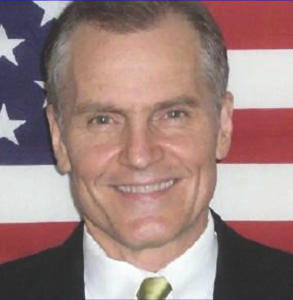
 As part of our commitment to helping Fairfax County residents make informed choices about local leadership, FABB invited all three candidates in the Braddock District special election to respond to our bicycling and active transportation questionnaire. Here are Independent Carey Campbell’s responses:
Do you own a bicycle? What is your Fairfax County cycling experience (commuting, recreation, errands, etc.)?
Yes. Our family’s Fairfax County cycling experience is positive. My wife and I have biked all the way to Mt. Vernon from North Springfield. And some years ago, just for fun, I biked from North Springfield to Dahlgren Virginia to visit family. As every biker knows, there is a tremendous energy surge after a long bike ride. From our house in North Springfield it is easy to bike to Lake Accotink and on to the Gerry Connolly Cross County trail that continues toward either Wakefield or Old Keene Mill thanks to the foresight of Fairfax County bikers and Supervisors like Audrey Campbell Moore. As my campaign manager Joe Oddo testifies, he has not seen such an elaborate 40-miles of “through the woods” trail network in any of his 1,600 miles of biking this year in a dozen different places from Charleston, South Carolina to Chico, California.
Errands on bikes are fairly easy from North Springfield to the shopping places at Bradlick Shopping Center, and Springfield Mall. The ride over to Kings Park and Old Keene Mill Plaza through the trails is safe and pleasant.
Commuting: Both my wife and I work in Washington DC. I have commuted with the bike to DC, but it is so circuitous and unsafe that under present conditions it is impractical by design. We need to install protected bike lanes to make it possible for everyone to commute by bike to all locations in the Metropolitan Washington area.
I promise and commit to you that I am the most pro-bike candidate in the history of Braddock District. We need to do in Fairfax & Braddock district what has been done in Denmark & Paris, France and many other places around the world. Replace an auto centric culture with a walkable, bikeable, pedestrian rail-friendly communities. That means protected bike lanes on nearly every road in the county. We need to bring bike share to Braddock District. Bike share to all three VRE stations, bike share to all the Metro stops in Fairfax County. We need to eliminate parking minimums. We need to end parking mandates. Each dollar spent on bicycle facilities creates 100% more jobs according to Jeff Speck’s book. Walkability and bikeabilitiy powers property values. Homes in Denver’s walkable neighborhoods sell at a 150% premium over those in drivable sprawl. Home values determine local property-tax revenue, justifying investments in walkability. Educated millennials value walkability. They want to live in a place where they don’t need a car.
How do you plan to support the continued implementation of the Active Transportation Plan?
Our campaign supports the bicycle elements of this new plan as actionable and robust – and we too will push for further funding and implementation after adoption. As Braddock District Supervisor, I will go farther, faster advocating for building carless, carfree communities. They lower infrastructure costs and create revenue. They cut housing costs and create affordability. Denver cut housing costs by 12% in carless, carfree communities.
We need road diets which as a Fairfax County DOT study shows which makes bikers, car drivers and pedestrians safer and creates more foot traffic for local commerce.
What percentage of County transportation funds do you think appropriate to earmark specifically for multimodal transportation (on street bike lanes, separated multiuse trails, etc.)?
At the very least we need ten times the current amount earmarked to build bikeable communities. Our campaign is advocating a dramatic shift as has successfully been done in Paris. It is a boon for the economy. Walkable, bikeable, pedestrian, rail-friendly communities are great for the economy. Every dollar we invest in bikeable communities grows the economy.
What percentage of County maintenance funds do you think appropriate to earmark specifically for existing multimodal infrastructure maintenance?
At the very least we need ten times the current amount earmarked to build our proposed walkable, bikeable, pedestrian, rail-friendly. A recent study followed 263,000 people over five years and found that those who biked to work had a 41% lower risk of dying prematurely. This included a 46% lower risk of developing heart disease and a 45% lower risk of developing cancer.
The best study on this subject was British and found that the health benefits of biking outweigh the risks by twenty to one. In New York, Washington, Chicago, Minneapolis, Portland and Seattle, increases in cycling over the past 15 years have lowered the rate of serious injury by an average of more than 64%.
In terms of public health investment, it is hard to imagine a more efficient wonder drug than bike lanes. The average person will lose thirteen pounds during their first year of biking to work. A U of Northern Iowa study found that cycling saves the state’s riders about $87 million in health care costs. Another study found that a $10 million biking investment provided New Yorkers with appx $230 m in net societal benefit, which included cleaner air.
Equity
Poor people are almost twice as likely to bike to work. The lowest earning quartile of Americans make up almost 40% of the bike commuting.
Investments in bike facilities disproportionately improve the safety of your community’s construction laborers and restaurant workers, and help to free them from the huge financial burden of car ownership.
Economics
Whether it comes to talent attraction and retention, job creation, household expenditures, home value, retail performance, or limiting costly externalities, bike lanes mean business. Young creative tech workers often cite bike infrastructure as a high priority in deciding where to live and work. A study shows that public dollars spent on bike infrastructure generate roughly twice the jobs as money spent on driving infrastructure.
The data make it clear: it would be difficult to find an investment that pays off better than bike lanes.
The Safe Routes to School program in Fairfax County has experienced staffing turnover and currently has approximately 3 staffers (including part time). Do you think the Safe Routes to School program is currently effective, and if not, how would you change it?
Add more funding, add more staff, accelerate deliverables. To accelerate the implementation of safe, connected bicycle and pedestrian infrastructure, I would allocate the remaining unspent funds to “quick-hit” or “spot improvement” projects that only require striping, flex-posts, paint, minor signage changes, and curb ramp upgrades. By creating a separate, fast-track permitting and design review process impacts can be delivered in months, not years, rapidly improving safety and network connectivity.
We should also establish large, pre-qualified, on-call engineering and construction contracts (ID/IQ contracts) specifically for pedestrian/bicycle projects. This avoids the time-consuming process of procuring a new firm for every single project.
Please rate (with letter grade A thru F) the current state of repair of County multimodal infrastructure (bike lanes, signage, safe crosswalks/intersections, multiuse trails). “A” rating signifying Fairfax County exceeds your standards, “F” rating signifying Fairfax County fails to meet any of your standards). If you rated the current state below “A”, what are your plans for improvement?
For the aspirational goals that our campaigns set, the current rating would be below a C. Using Freiburg, Germany (the Greenest city on Earth) as a standard, we rate this area a D. We can achieve a walkable, bikeable, pedestrian, rail-friendly community through increased funding and faster implementation of multimodal transportation. We need More Trains, Less Traffic. The county should continue to invest in and complete numerous pedestrian and bicycle projects, including sidewalk gap closures, new crosswalks with signals, pedestrian refuge islands, and protected bike lanes.
Install bike share at all county schools. Take thousands of polluting, rolling tons of steel off roads. Save lives. Cut accidents. Over 40,000 Americans are killed every year on our highways. Annually, there are over 5 million reported medically consulted injuries. Less traffic means safer students, safer families.
What policies will you recommend to ensure cyclists, pedestrians, and motorists can all travel safely in the county?
We need protected bike lanes on the majority of roads in the county to facilitate commuting, errands and recreation. We need More Trains, Less Traffic. We need walkable, bikeable, pedestrian, rail-friendly communities. We need to bring bikeshare to Braddock and all our schools. This is how we make our staff and students safer and more secure. A robust Safe Routes to School program can play a critical role in encouraging more families to walk and bicycle safely to school.
Is there anything else you would like us to know about your views of bicycling in Virginia?
The city of Copenhagen calculates that every mile driven by car costs the city 20 cents, while each mile biked earns the city 42 cents. Substantial positive long-term impacts can drive a bright economic future for Fairfax County, while lowering obesity and creating a healthier population. Ours is the most pro-bike Braddock District campaign in history. We encourage you to endorse our campaign for Braddock District.


